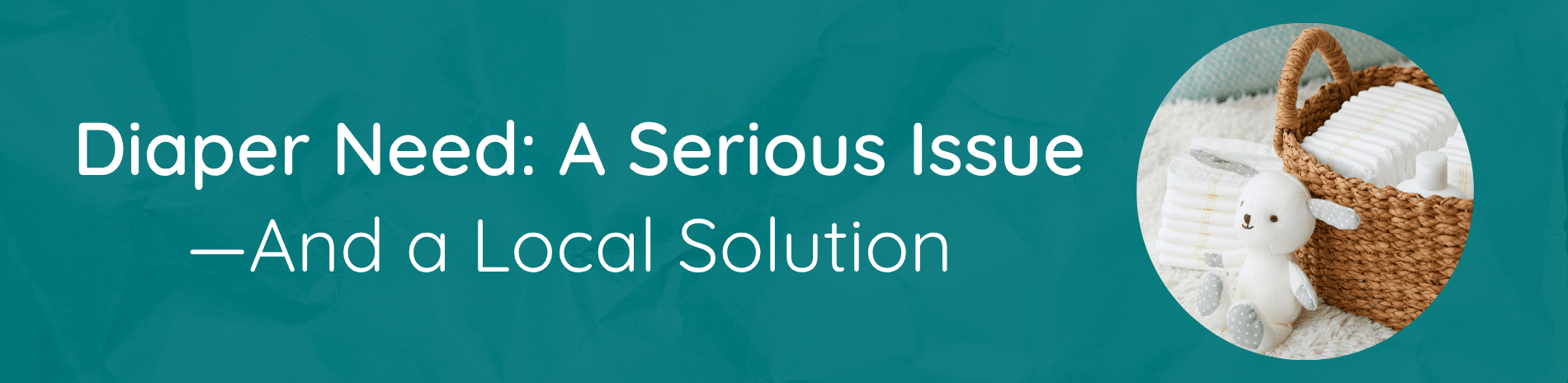
When expecting a new baby, people think of gifting cute newborn clothes and hats, nursery decor, and specialty items like baby swings.
Diapers are often an afterthought for family and friends for baby shower gifts, aside from the fancy diaper cake decorative centerpiece.
But diaper need is a real issue for many new parents. What is diaper need, what is a diaper bank, and how can you get involved in helping bridge the gap?
What is diaper need?
Diaper need is a widespread, systemic issue. According to the National Diaper Bank Network (NDBN), diaper need is “the lack of a sufficient supply of diapers to keep a baby or toddler clean, dry, and healthy.”
To make matters worse, diapers are taxed as a “luxury item” in the US—contrary to common sense, as diapers are a basic need. Diaper need is not only a systemic, economic issue, but a public health issue, as well.
In fact, half of all families in the United States struggle to meet the diaper needs of their baby or toddler.
Diaper need forces painful choices for parents.
Because a healthy supply of diapers can cost around $75 a month, many parents are forced to decide between other basic needs of the household, such as bills and utilities, or diapers.
Ever-rising inflation and cuts to Medicaid, WIC, and SNAP are forcing families to make impossible decisions, like skipping meals to afford diapers.
Diaper need causes parents to miss work and school.
Childcare facilities require parents to supply diapers for their children, which means that many parents miss work or school when their supply runs out.
National data indicates that one in four parents miss work due to facing diaper need. In Oregon, 65% of mothers with infants work.
It’s clear that diaper need perpetuates the poverty cycle when working parents can’t access childcare to go to work or seek higher education because of a lack of diapers.
Diaper need impacts parents’ mental health.
Research shows that not being able to afford diapers can impact parents’ mental health and their ability to parent.
Nearly 80% of mothers experiencing diaper insecurity report depression and anxiety and 60% report low self-esteem. It is critical to mental and emotional well being for families that diaper need is addressed.
Diaper need is a public health issue.
Not having enough diapers can cause parents to leave their children in soiled diapers for longer than they should, which can lead to health complications, including diaper rashes and urinary tract infections for babies and toddlers.
Children in families facing diaper need are more likely to seek medical care due to UTIs, colic, and other health issues.
Diaper need is economic injustice.
Not surprisingly, low-income families who rely on TANF (Temporary Assistance for Needy Families), SNAP (Supplemental Nutritional Assistance Program, also known as Food Stamps), and Medicaid grapple with diaper need at higher rates than families not enrolled in these programs.
There is a stigma associated with being enrolled in these programs, and this is compounded with the mistaken belief that these programs help supply diapers.
In fact, diapers are not recognized by government safety-net programs as a basic need.
Addressing diaper need requires a change in mindset and reframing of the issue of poverty from individual to systemic. Diaper need as an issue is tied to other basic needs deficits like period poverty or menstrual poverty and lack of needed incontinence products for older people.
Many people take having access to their basic needs for granted, and lack empathy for those trapped in systemic poverty, which disproportionately affects women and children of color because of economic and institutional racism. Low-income families pay more per diaper, being unable to buy in bulk.
Let’s change the conversation!
How big is the gap?
According to the Urban Institute, an average of 4.8 billion diapers each year are needed to fill the diaper need faced by US households with children 3 and younger and below 300 percent of the federal poverty level.
What are diaper banks?
Diaper banks are networks designed to help fill the gaps for families in need. In Oregon, diaper banks help almost seven thousand infants and toddlers monthly by distributing nearly 4 million diapers annually. On a national level, the support is over 243 million diapers distributed annually.
What about cloth diapers?
While cloth diapering can be a sustainable solution for some, the start-up costs can be prohibitive to many low-income families.
Some diaper bank locations provide cloth diaper options to families, as well as education on the topic, which can be a mystifying and overwhelming process to many new parents.
- Cotton Babies Share the Love supplies low-income families with cloth diapers in 100 locations across the US. Founder Jennifer Labit experienced diaper need herself as a low-income mother. After being provided with a three-month supply of cloth diapers from her local cloth diaper service, she was inspired to help expand access to other families like herself. Visit the join and donate page to spread awareness or donate.
- The Cloth Option operates as an expanded loan system cloth diaper bank.
How can you get involved?
- Diaper banks rely on volunteers. Find a diaper bank in your area and volunteer your time.
- Donate diapers to your local diaper bank.
- Help spread the word about diaper need and local diaper drive efforts.
- If there is not a local diaper bank or diaper drive in your area, start one.
Supporting families close to home
You can make a real difference for families facing diaper need in our community.
Through its partnership with Oregon State University, the Community Doula Program helps ensure parents have access to the diapers they need. Online donations directly support this effort.
April 2, 2026
Explore the Blog
What Is a Non-Stress Test During Pregnancy?

Why Choose a Community Doula?

How Many Ultrasounds Should I Have During Pregnancy?
Explore the Blog
What Is a Non-Stress Test During Pregnancy?
Why Choose a Community Doula?